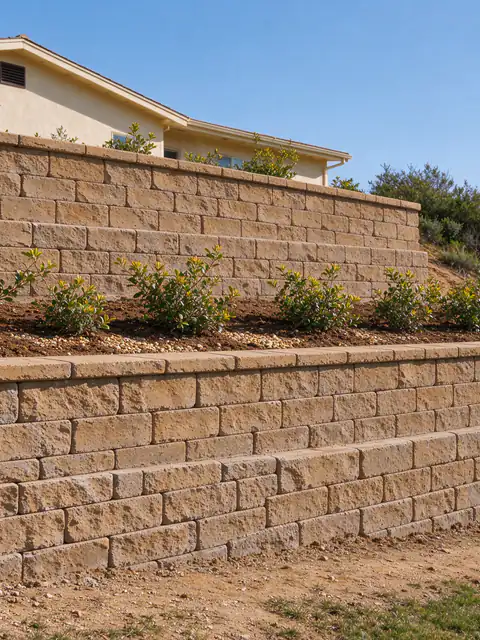
What changes when you build a retaining wall on a San Diego canyon lot?
The fire, hillside, open space and geology rules that apply where a San Diego yard meets a canyon, and who is responsible for the slope below the fence.
Last Updated:
Short answerOn a San Diego canyon lot, a retaining wall within 35 feet of the house in brush Zone One must be noncombustible, one-hour rated or heavy timber, so block, concrete or stone usually replaces wood. Steep-hillside rules, City open space and slide-prone formations can add permits and engineering, and the slope is usually the owner's to maintain.
A canyon lot retaining wall in San Diego has more rules to satisfy than the same wall on a level yard, and most of them come from what sits beyond the back fence: native brush, a steep slope, City open space and soft canyon-side ground. On canyon-edge lots across the city, Batterline San Diego Retaining Walls offers and manages hillside retaining walls, slope repair and repairs, and this guide walks through the four rule sets that change the design and the one that changes who pays.
The city has a lot of canyon edge. San Diego Fire-Rescue counts over 500 linear miles of wildland-urban interface in the city, where homes meet dense vegetation in canyons and other open space. No count of canyon-rim lots exists, but grid samples of Very High Fire Hazard Severity Zone coverage give a sense of it: about 97% of Tierrasanta, 94% of Rancho Penasquitos and 70% of Clairemont.
Brush management Zone One and wall materials
Where native or naturalized vegetation exists, City code requires brush management within 100 feet of a structure, split into Zone One, the first 35 feet, and Zone Two, the next 65 (SDMC 142.0412). Structures in Zone One, the code says, including “fences, walls, palapas, play structures, and non-habitable gazebos,” must be of noncombustible, one-hour fire-rated or Type IV heavy timber construction.
For retaining walls, that narrows the materials near the house:
Doesn’t meet the rule unless it qualifies as heavy timber or rated construction
San Diego Fire-Rescue’s defensible space guidance points the same way, recommending noncombustible replacements for combustible fencing, gates and arbors and hardscape within 5 feet of the house. Fire Hazard Severity Zone status for permit applications deemed complete after August 30, 2025 follows the City’s updated map adopted by Ordinance No. 21992. A wood wall on a canyon lot that is rotting out is a common candidate for timber retaining wall replacement in masonry for both reasons.
Clearing brush to reach the slope
Wall work on a canyon edge often needs room to dig, and that runs into the same brush rules. Brush management is prohibited in coastal sage scrub and chaparral habitats from March 1 to August 15 except as consistent with the City’s MSCP Subarea Plan, and Zone One isn’t allowed on slopes steeper than 4:1, apart from a pre-1989 map exception (SDMC 142.0412). That can shape when a project starts. The construction timeline guide shows where it fits.
Steep hillsides, open space and the MHPA
Canyon slopes are often environmentally sensitive lands. A steep hillside in City code is land with a natural gradient of 25% or more and at least 50 feet of elevation difference, or 200% or more with at least 10 feet (SDMC 113.0103). When any part of a lot contains environmentally sensitive lands, the regulations apply to the whole premises, encroaching on them takes a Neighborhood or Site Development Permit (SDMC 143.0110), and the short-wall permit exemption no longer applies (SDMC 129.0203). Outside the Multi-Habitat Planning Area, steep hillsides are preserved apart from development on up to 25% of the premises, or 40% in listed cases (SDMC 143.0142). Whether a lot borders MHPA land is a parcel-level question for the City’s maps, not something to assume from the view.
Open space adds a separate trigger. Any grading in City-owned open space or an open space easement needs a grading permit, regardless of size (SDMC 129.0602). A wall footing or drain outlet that reaches past the back fence into City land isn’t a backyard project anymore. Every part of a City standard wall also has to stay on the owner’s own property (IB 221), so a survey of where the lot ends is often the first step on a canyon rim.
Slide-prone ground on canyon sides
The City’s Seismic Safety Study marks several bedrock formations as slide-prone: Friars, Ardath, and Otay, Sweetwater and others (categories 23 to 27), and canyon lots are the ones most worth checking against them. A wall over 6 feet, or a surcharged wall, in those categories needs a geotechnical report (SDMC Table 145.1803), and the City’s standard wall drawings can’t be used where there are landslides or slope instability (IB 221). Grid samples show 39% of Tierrasanta and 14% of Clairemont in slide-prone categories. That doesn’t put any one lot there; the parcel’s grid tile does.
Access on a canyon edge
The ground behind a canyon wall is usually the hardest place on the lot to reach. Footing excavation, the drainage zone and, on segmental walls, the geogrid zone all need digging behind the wall, and equipment rarely gets down a canyon side yard. Hand-carry access and staging on the level part of the lot move both the method and the price. Excavation next to a steep slope also has to protect adjacent property during the work (SDMC 142.0148), and excavations 5 feet or deeper that workers enter need a Cal/OSHA permit.
Water is the other constant. Runoff from the house and yard heading for the canyon should be collected and carried to an approved outlet, not dumped over the edge where it erodes the slope and saturates the soil behind the wall. The City’s standard design requires the wall drain to discharge to a stormwater system and never onto an adjoining property.
Who maintains a private canyon slope
The slope behind a house is usually private, and so are the walls on it. City code requires owners to keep retaining walls free of dilapidated or dangerous conditions (SDMC 142.0380). Homeowners have reported the City saying that upper canyon slopes are typically private property and declining to evaluate a home with no City utilities underneath. Where a slope failure involves a neighbor’s wall or a shared boundary, the guide to who is responsible for a retaining wall covers that question, and the storm damage insurance guide covers what to ask an insurer.
Planning a wall on your canyon lot
Before design, settle four things: the brush zone the wall sits in, whether the lot carries steep-hillside or open space limits, the parcel’s geologic hazard category and the property line. To have those checked for your lot, call (619) 374-2499 or ask for an estimate with the address and photos of the slope; the San Carlos and Del Cerro and Tierrasanta pages cover two canyon-heavy areas in more detail.
02
More questions on this
Can a retaining wall drain empty into the canyon below?
Not just over the edge. The City's standard wall design requires the wall drain to discharge to a stormwater system and never onto an adjoining property (IB 221), and water dumped over a canyon rim erodes the slope the wall depends on. Any outlet work that reaches into City open space or an open space easement also needs a grading permit (SDMC 129.0602).
Can a wood retaining wall be used near a house on a canyon lot?
Within brush management Zone One, the 35 feet nearest a structure where native or naturalized vegetation exists, walls must be noncombustible, one-hour fire-rated or Type IV heavy timber under SDMC 142.0412, so ordinary landscape timbers and railroad ties don't qualify. Beyond 35 feet the code is less strict, but fire guidance still favors masonry near the house.
Can canyon brush be cleared to make room for retaining wall work?
Within limits. Brush management is restricted in coastal sage scrub and chaparral from March 1 to August 15, except as consistent with the City's MSCP Subarea Plan, and Zone One isn't allowed on slopes steeper than 4:1 in most cases (SDMC 142.0412). Grading or clearing into City open space or an open space easement needs a grading permit.
03
Get an Estimate for hillside retaining walls
Tell us what the wall is doing, how tall it is from the lowest visible point, what sits above it and your ZIP code. Photos of the face, the top and any drain outlets make the first conversation more useful.
How poured concrete, reinforced block, segmental block, stone and timber compare on load, drainage, access, fire rules and lifespan, and why frost barely matters near the coast.
The signs worth looking for once a storm passes, how to look without putting anyone at risk, and why short bursts of San Diego rain are hard on walls built for a dry climate.
How ownership, recorded agreements, HOA documents and City rules point to who maintains a wall, what the City expects of owners, and where to look before a dispute starts.
What the City of San Diego, Encinitas and Solana Beach allow near a bluff edge, why bluff work is engineered and permitted case by case, and which parts of it sit outside ordinary residential wall work.