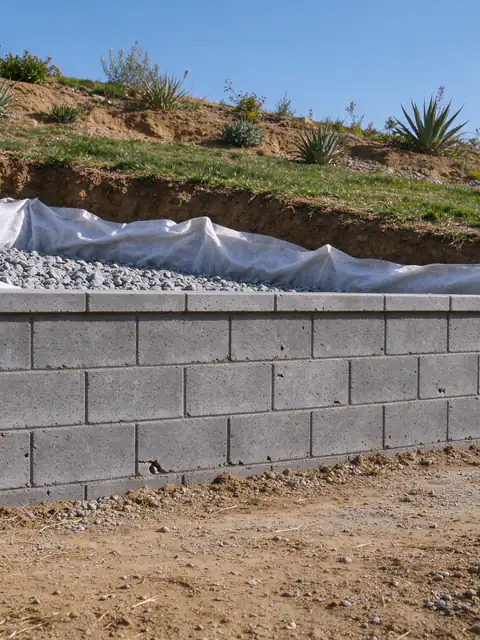
Why every retaining wall needs an outlet for water, how weep holes compare with a perforated back drain, what San Diego's City and County designs call for, and what water and stains on the face are telling you.
Last Updated:
Short answerEvery retaining wall needs a way for water to leave the soil behind it, but weep holes are only one way. County prescriptive block walls use 4-inch drains through the bottom course every 6 feet. City standard walls use a perforated pipe behind the wall piped to a storm drain. Either one works only with gravel behind it.
Do retaining walls need weep holes? Every retaining wall needs a way for water to get out of the soil behind it. Weep holes are one way; a perforated drain behind the wall is another, and some walls use both. What matters is the whole drainage path, from the gravel that collects water to the outlet that releases it. Batterline San Diego Retaining Walls offers and manages retaining wall drainage work and drainage repairs across San Diego County, and this guide explains how each design works and what the water on your wall’s face means.
Why water has to leave the wall
Soil behind a wall that fills with water gets heavier, and water that can’t escape presses against the back of the wall on its own. Together those raise the load well past what a dry wall carries. A drainage system keeps the backfill from saturating: gravel next to the wall collects water, a pipe or an opening carries it out, and a filter keeps soil from clogging the gravel.
The drainage behind a wall handles water that soaks into the backfill. It isn’t a storm drain for the yard: water pouring over the top of the wall from a downspout or a slope needs to be sent elsewhere, or it overwhelms the wall’s drains and erodes the ends and the toe.
Weep holes and back drains compared
Weep holes
Perforated back drain
How it works
Openings through the wall near its base let water out of the gravel behind
A perforated pipe along the base of the gravel collects water and carries it to an outlet
Where water leaves
At the face, along the toe of the wall
At an outlet the designer chooses, often piped to a storm drain or the street
Weak point
Water discharged at the toe can wet the footing area and stain the face; small openings clog
The outlet has to be kept open, and a crushed or silted pipe is hidden
Needs behind it
Gravel and filter fabric, or it clogs or leaks soil
Gravel and a filter sock or fabric
Segmental block walls drain partly through their open joints and the gravel in and behind the units, usually with a toe drain as well. Poured concrete walls use weep holes, a back drain, or both, often with a drainage layer or waterproofing on the back face.
What San Diego’s designs call for
The City and County prescriptive walls take different approaches. County bulletins PDS 083 and 084 call for 4-inch wall drains at 6-foot intervals at the bottom course, with at least 12 inches of gravel behind the drains or open head joints. City Information Bulletin 221 calls for a 4-inch perforated pipe in a filter sock along the full length of the wall, a 12-inch gravel layer behind the wall from the top of the footing to 12 inches below finished grade, and discharge to a stormwater collection system. The City’s bulletin also prohibits wall drainage that discharges onto adjoining properties, which matters on a lot that slopes down to a neighbor. Engineered walls follow their own drainage details, and the backfill and drainage inspection before the wall is buried is when they are checked. The retaining wall permit guide lists the inspections.
Where the water goes once it is out
The outlet is where drainage succeeds or fails. Water released at the toe has to move away from the footing, not soak in beside it, or it softens the soil the wall stands on and can undermine the toe over time. Water carried to an outlet has to reach somewhere it can go: a storm drain, a curb outlet or another approved discharge point. A pipe that ends in a buried planter, or an outlet covered by mulch and groundcover, works no better than no pipe.
San Diego’s rain makes outlets easy to forget. About 83% of Lindbergh Field’s average rainfall comes from November through March (NOAA climate normals), so outlets sit dry for months while roots, soil and debris collect in them. Checking that they are open before the rainy season, as the pre-season wall check explains, matters more here than in places where walls drain all year.
What water and stains on the face mean
What shows on the face is a clue to what is happening behind it, though no single sign proves a cause:
White crust (efflorescence). Salts carried to the face by water moving through the wall. The wall itself is passing water.
Rust-colored stains from cracks. Water reaching the steel in block or concrete. Corroding steel expands and can split the wall around it.
Soil streaks below joints or outlets. Fines washing out of the backfill, which means the filter has failed or was never there, and voids may be forming behind the wall.
A wet toe with dry outlets. Water finding its way under or around a drain that is blocked, crushed or missing.
Wet patches far from any outlet. Water moving through the wall body, often where the gravel layer is thin or absent.
Water that appears with no rain is usually irrigation, from planters above the wall or a neighbor’s yard upslope. When the wall is also leaning or bulging, the drainage is probably part of the reason, as the guide to why walls lean explains.
Why drilling more weep holes rarely fixes it
New holes drilled through a wall drain only the water that can reach them. With no gravel and filter behind the wall, they clog with soil or let it wash out, and drilling grouted block or concrete can cut the steel. When the drainage zone itself is missing or silted up, the lasting fix is opening the back of the wall and rebuilding the gravel, filter and pipe. Where water has already moved the wall, the drainage is rebuilt along with that length of wall, covered in the retaining wall repair page and the guide to repair or replacement. Clay backfill makes all of this harder, as the expansive clay guide explains.
Checking your wall’s drainage
To find out whether a wall’s outlets, gravel and pipe are doing their job, call (619) 374-2499 or ask for an estimate with photos of the face, the outlets and the toe, taken after rain if you can.
02
More questions on this
Do segmental block walls need weep holes?
Not in the drilled sense. Segmental units are dry-stacked, so water can pass through the joints between them, and the gravel placed in and behind the units carries it down to a perforated toe drain along the base. Those parts do the work weep holes do in a solid wall, which is why a segmental wall whose gravel has silted up starts weeping soil through its joints.
Why is water coming out of my retaining wall when it hasn't rained?
Irrigation is the usual suspect, from your own planters above the wall or a neighbor's yard upslope. Leaking pool plumbing, a broken irrigation or water line, or groundwater in a low area can do the same. Shut off irrigation zones one at a time and watch the outlets for a few days. Water that keeps running with every zone off points to a leak or groundwater.
Should water run out of weep holes after a storm?
Yes, that is their job. Clear water running for a while after rain, then slowing to a stop, means the drainage is working. Outlets that stay dry while the face or the toe is wet suggest they are blocked or have nothing behind them. Muddy water or soil washing out means fines are migrating through the drainage, which a filter fabric is meant to stop.
03
Get an Estimate for retaining wall drainage
Tell us what the wall is doing, how tall it is from the lowest visible point, what sits above it and your ZIP code. Photos of the face, the top and any drain outlets make the first conversation more useful.
The pressures that push a wall over, the three ways walls move, why San Diego's rain pattern and clay matter, and how to record the lean before anyone visits.
The signs worth looking for once a storm passes, how to look without putting anyone at risk, and why short bursts of San Diego rain are hard on walls built for a dry climate.
The three scopes a failing wall can get, the buried conditions that decide between them, how reinforcement is checked when you can't see it, and what changes in permits and price.
Why shrink-swell clay pushes harder on a wall, where it is mapped across San Diego County, and what an expansive soil retaining wall needs that a wall on sandy ground doesn't.
Every trigger the City of San Diego and the County use, from the 3-foot rule and surcharge loads to engineering, soils reports, coastal permits, zoning heights, licensing, fees and inspections.